Small solar. Real answers. Can a renter plug in solar?
California has passed a law to clear the way for small plug-in solar. Whether it works in your rental depends on your place, your lease and your landlord. We’re researching how San Diego renters and landlords can work that out together, so renters are the ones who benefit.
Our model estimate for San Diego, not a measurement or a promise: about 780 to 1,240 kWh a year, depending on how the panels are mounted. For scale, the main refrigerator in an average U.S. home uses about 1.7 kWh a day (EIA). A kit only helps with power you use while the sun is up. How we estimate
At a glance
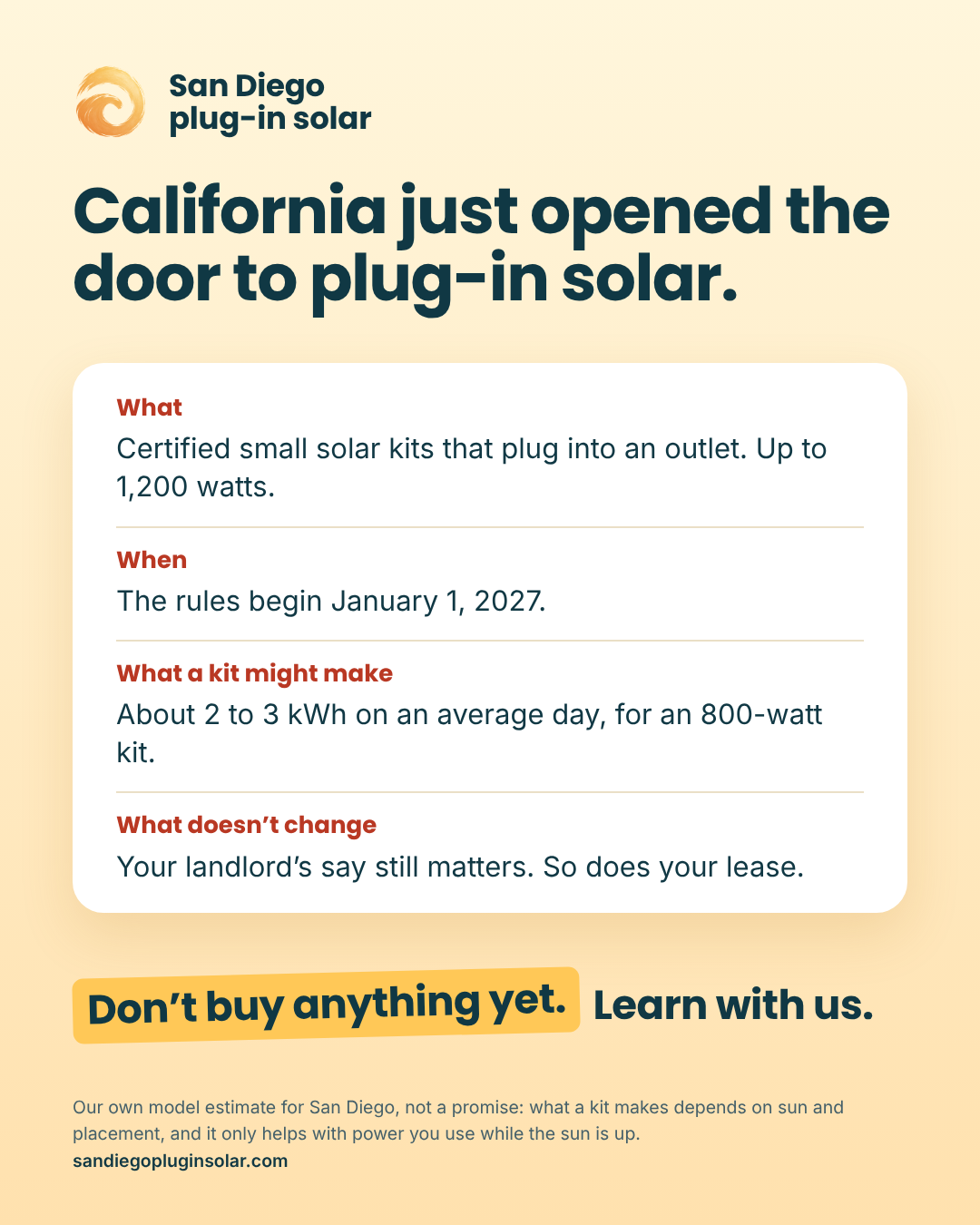
California just opened the door to plug-in solar.
What
Certified small solar kits that plug into an outlet. Up to 1,200 watts.
When
The rules begin January 1, 2027.
What a kit might make
About 2 to 3 kWh on an average day, for an 800-watt kit.
What doesn’t change
Your landlord’s say still matters. So does your lease.
Don’t buy anything yet. Learn with us.
That figure is our own model estimate, not a promise: what a kit makes depends on sun and placement, and it only helps with power you use while the sun is up.
Every idea on this site gets one test: does it help the person paying the electric bill? Landlords are partners in making it work, but the point is renters getting access to solar power they’ve been shut out of.
Where we are
SB 868 is law. It clears the utility paperwork, and only that.
California enacted SB 868 on September 30, 2026. The rules begin January 1, 2027, in just a few weeks. Here is what the law does, and what it leaves for the rest of us to work out. Good people and groups are already on it, and we want to help in San Diego, our home. We’re still figuring this out, so tell us what you think.
What the law changes
The utility hurdle
Qualifying devices can skip utility interconnection approval and related fees during the law’s temporary window. The exemption covers only devices that meet the law’s definition. The utility may ask for a simple online notice.
The exemption is scheduled to end January 1, 2030 unless extended. Read the enacted law ↗
What it doesn’t settle
The rest of the checklist
Landlord or HOA permission, local permits, safe mounting, suitable wiring, and actual bill savings. Those are the questions we’re building around.
That gap is where a good, fair process between renter and owner matters.
The idea we’re testing
A “yes” made easier.
Plug-in solar needs two things: a sunny spot and a property owner who’s on board. Most renters can find the first. We’re exploring how to help with the second.
1
Start with your place
Balcony, patio, or a sunny wall? Which way does it face? Who owns the building? Any request starts with those answers.
2
A clear ask
A complete request for the property owner could cover: where it goes, how it’s mounted, which certified device, and how it comes out when you move.
3
Plug in, together
Everyone’s on the same page, the equipment checks out, and the sun does the rest.
This is an idea we’re researching, not a live service yet. Interest helps us decide what to build.
Renters and owners
Where do you fit in?
The goal is the same either way: renters benefit.
For renters
You’ve got the sunshine and the motivation.
What you might not have is permission. We’re working on ways to help you ask well.
SB 868 addresses utility interconnection. Whether landlord approval is required is still an open question, so we’re researching what a fair, complete request looks like.
A full request, not a surprise panel on the railing
Certified equipment, with the listing to prove it
Clear terms in writing before anything is installed
We start with the issues that decide whether a renter can actually use a system.
01 / Rights
Can my landlord say no?
Today, usually yes. SB 868 only stops utilities from blocking a certified kit. It gives renters no right against a landlord, and how other California law applies is untested. Our renter page explains what to do next.
02 / Safety
What makes a system safe?
Certification, anti-islanding, wiring, mounting, and local code questions all matter. Product labels alone are not enough.
03 / Economics
Will it lower my bill?
Output depends on shade, orientation, daytime use, equipment, and the rate on your SDG&E bill.
Looking out for renters
Renters should come out ahead, not get squeezed.
Not by a landlord, and not by a solar salesperson. Here is what we’d watch for, and what we’re researching so you don’t have to learn it the hard way.
In writing
Get the deal on paper
Before anything goes up, we’d want it written down: who owns the equipment, who pays for what, and what happens when you move out. A handshake isn’t enough.
No surprise fees
Watch the money
Ask whether the panel comes with a rent increase, a new fee, or a charge for the power it makes. These are questions to settle up front, and exactly the kind of terms we’re researching.
“Free” isn’t free
Be wary of the sales pitch
Consumer groups have told federal regulators about rooftop-solar sales with misleading “free” claims and financing fees that raise the real cost by 15 to 30 percent. Understand every lease, loan or contract before signing.
General information, not legal advice, and no attorney-client relationship is created. Your lease and your landlord’s situation matter, and these questions are still unsettled in California. See the full disclaimer.
Why San Diego
We have the sun. A lot of us don’t have the roof.
Rooftop solar has mostly worked for people who own their roofs. Plug-in solar is small enough to fit the places renters actually have.
Ocean Beach, San Diego
Sunset, covered.
North Park, San Diego
Your block.
Leipzig, Germany
What it looks like.
Picture it
Now picture your building with plug-in solar.
This is an illustration, not a forecast. Slide it to see roughly what it could mean if more neighbors in a complex joined in, and change any assumption to match your own place.
A silent, six-second illustration of an apartment building. Small solar panels appear on its balconies one by one, to suggest what it could look like if many neighbors joined in.
What the video shows: A silent, six-second illustration of an apartment building. Small solar panels appear on its balconies one by one, to suggest what it could look like if many neighbors joined in. AI-generated illustration, not a photo of a real installation or of a specific San Diego building. It shows an idea, not a forecast or a promise.
0kWh of solar power used each year
$0in avoided electricity purchases each year
0metric tons of CO2 avoided each year
Change the assumptions
Where the starting numbers come from. They are taken from the one savings model this site uses, using its low case for how much a kit makes: an 800-watt kit hanging flat on a south-facing railing, making about 975 kWh a year for each kilowatt (our own run of the federal PVWatts calculator, an estimate), with 60 percent of that used at home as it is made. Each kWh is valued at 39 cents, the middle of our 33-to-44-cent range. That range falls within the daytime prices in SDG&E’s rate table for its standard time-of-use plan, effective August 1, 2026, which run from about 27 cents with the baseline credit to about 53 cents without it. Carbon uses the EPA’s average rate for the California grid region (CAMX), 428.5 lb of CO2 per MWh, from eGRID 2023 Summary Tables, revision 2 (EPA eGRID summary data). That is a yearly average for the whole region. It shows scale. It does not measure what any one kit avoids. Nobody has measured plug-in solar results in San Diego yet, and real results depend on shade, direction and how much power you use in the daytime. Treat everything here as an illustration, not a forecast or a promise.
Already happening
In Germany, balcony solar has become a common sight.
Many renters there hang a couple of panels on a railing and plug into an outlet, with no roof and no rooftop contractor involved. Here are real ones.
800 WGermany’s limit per system, raised from 600 W in 2024Clean Energy Wire ↗
1stUtah became the first U.S. state to allow it, in 2025Grist ↗
1,200 WPeak power, and the cap in SB 868. Our estimate for an 800 W kit: about 2 to 3 kWh on an average day.California: the facts
Photos are real balcony systems in Germany (locations shown on each photo). Austria, the Netherlands, Belgium, France and Poland have also seen growth, according to AVEVA and The Conversation.
What people say
Ask the people who already have one.
“You just hang them from the balcony like wet laundry in Italy.”
The panels cost money. The renter should still come out ahead.
A small system can save only a modest amount each month, and a loan, lease or service fee can swallow that fast. So we look at the whole cost. Results vary, and nothing here is a guarantee.
Wide range
What it costs
Published kit prices we checked run from about $285 for a small member kit to about $2,400 for a 1.2 kW set, before delivery, mounting and any fees. Sizes differ, and not every kit qualifies in California.
Nobody has measured savings in San Diego yet. Our model for an 800-watt kit comes out at roughly $150 to $330 a year, depending on shade, direction, daytime use and the rate on your SDG&E bill.
These are reported results from Germany, not San Diego. Reports put typical savings at around $100 a year in Germany, and about €228 for a 600 W system at 2023 prices. Payback is often cited at roughly 3 to 5 years.
Many systems hang from a railing or stand on a balcony, so they can often come with you when you move. Where you can mount one, and whether you need a landlord’s OK, is part of what we’re researching.
Estimates, not promises or guarantees. Savings depend on shade, which way your balcony faces, how much power you use in the daytime, and your SDG&E rate. See the full disclaimer. Try a savings calculator with your own address and bill before counting on any number.